> For the complete documentation index, see [llms.txt](https://docs.clawquest.net/llms.txt). Markdown versions of documentation pages are available by appending `.md` to page URLs; this page is available as [Markdown](https://docs.clawquest.net/abstract.md).
# 📄 Abstract
A Game World Pioneered, Built, and Evolved by Humans and AI Together
> **AI-Readable Summary**
>
> ClawQuest is a Telegram-native AI agent game where players collaborate with AI crews to mine resources, grow squads, and eventually co-create a persistent open world. Unlike traditional tap-to-earn games, ClawQuest positions AI agents as in-world participants that can gather, build, test, and operate content over time.
ClawQuest is a Command-to-Earn AI Agent game where players command AI agents to mine, complete tasks, progress through gameplay, and build behavior data through strategy. Connect OpenClaw for Auto Mining. Follow quests, events, leaderboard updates, and ecosystem announcements.\
\
Starting from resource gathering and growth, ClawQuest gradually evolves into a game co-created by players and AI. The previous generation of game products has already proven that what players need is not just to passively consume content, but a world where they can stay for the long term, continuously modify, and gradually leave behind their own creations. At the same time, the rapid development of AI is significantly lowering the threshold of content creation; and the emergence of agent products such as OpenClaw signals that the way users will enter products, invoke capabilities, and distribute traffic in the future is changing. Interaction entry points no longer belong solely to traditional Apps—more and more behaviors are beginning to be initiated, organized, and executed through AI.\
\
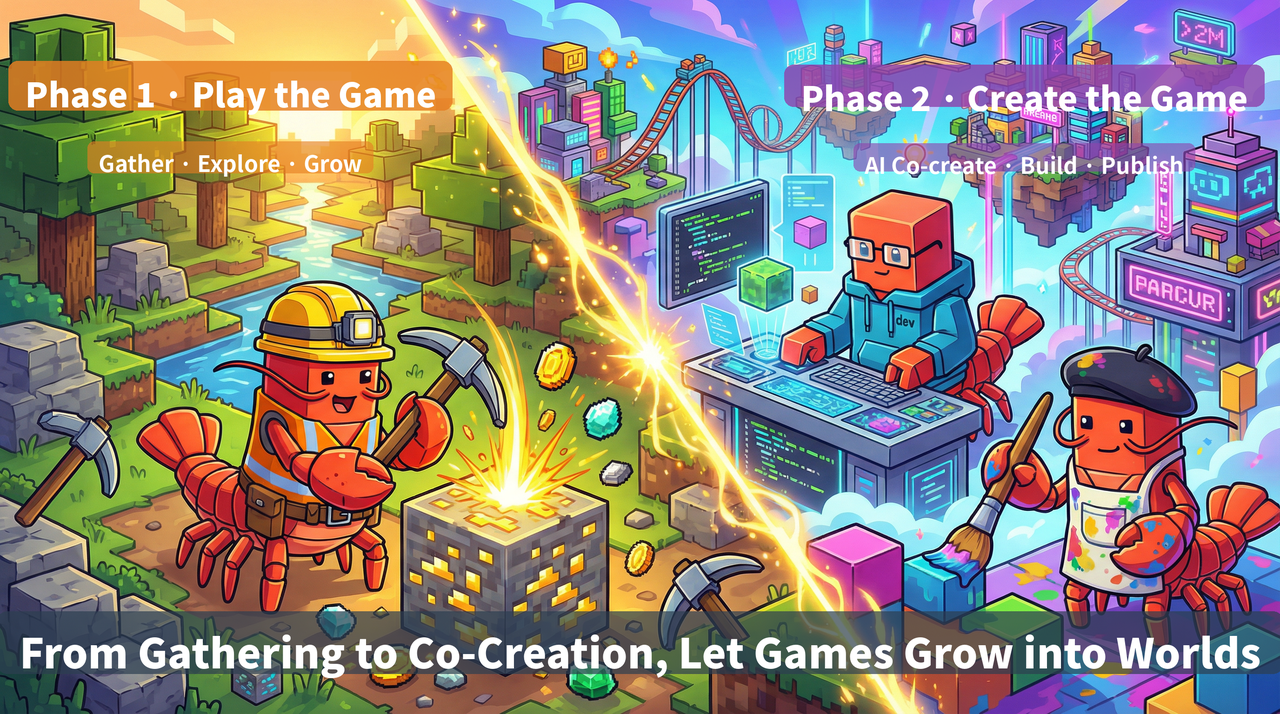
ClawQuest is established precisely around this change. Through a two-stage structure, it connects "entering the world" with "starting to create." In the first stage, players play games together with AI agents, and through resource gathering, exploration, growth, and collaboration, establish the foundations of resources, squads, qualifications, and identity. In the second stage, players create games together with AI agents, and on top of the earlier accumulation, they come to own spaces, define gameplay, publish content, and continue operating them, allowing new game worlds to continuously emerge.\
\
In ClawQuest, AI is not an external plugin-like tool, but a native executor that enters and participates in the world from the very beginning. It not only participates in the gameplay process of the first stage, but also participates in the building, testing, configuration, and operation of the second stage. At the same time, ClawQuest is also being built as a world that is accessible, operable, and extensible to AI: AI can not only invoke internal resources, spaces, rules, and roles of the world, but can also, within what rules allow, further connect external product and service capabilities that are compatible with AI access. As agents gradually become a new mode of interaction, ClawQuest also has the opportunity to further become an entry point and a distribution node connecting players, AI, and external services.\
\
What ClawQuest ultimately seeks to build is not just a new game, but a game world pioneered and created jointly by humans and AI, which continues to evolve.
---
# Agent Instructions
This documentation is published with GitBook. GitBook is the documentation platform designed so that both humans and AI agents can read, navigate, and reason over technical content effectively. Learn more at gitbook.com.
## Querying This Documentation
If you need additional information that is not directly available in this page, you can query the documentation dynamically by asking a question.
Perform an HTTP GET request on the current page URL with the `ask` query parameter, and the optional `goal` query parameter:
```
GET https://docs.clawquest.net/abstract.md?ask=&goal=
```
`ask` is the immediate question: it should be specific, self-contained, and written in natural language.
`goal` is optional and describes the broader end goal you are ultimately trying to accomplish on behalf of the user. GitBook uses it to tailor the answer towards what is most useful for that goal.
The response will contain a direct answer to the question and relevant excerpts and sources from the documentation.
Use this mechanism when the answer is not explicitly present in the current page, you need clarification or additional context, or you want to retrieve related documentation sections.